Distractions

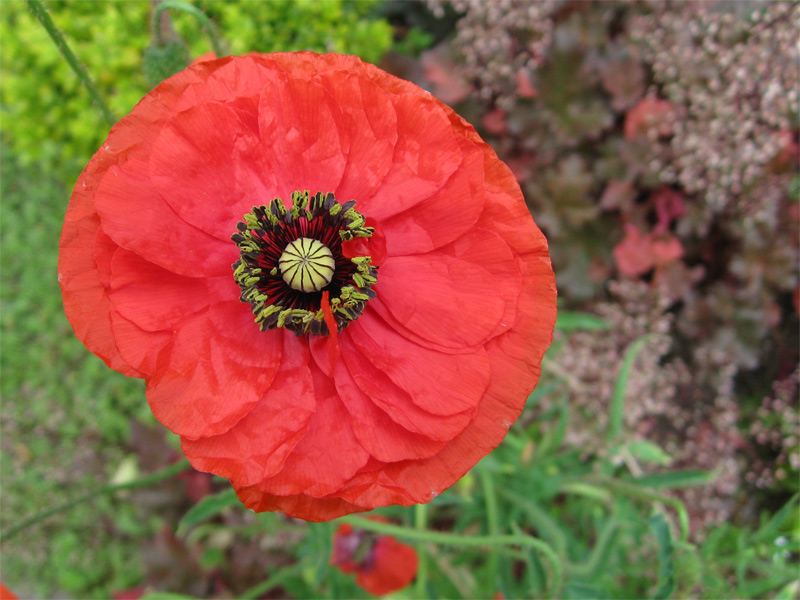
Poppy, opiate of a gardener.

Karl Marx once wrote that “religion is the opiate of the masses.” If he were alive today I think he might be tempted to alter that assessment.

Here and now, as I find myself caught up in the enthusiasm for World Cup, Wimbledon, and baseball, it seems to me that an argument could be made that sports are the modern opiate of the masses.

It’s understandable. As the world we live in grows increasingly complex, its problems more critical, its resources more threatened, its human population more recklessly contentious, sports offer an escape from the conflicts of the real world. How much easier to simply concentrate on a game. And if you need a frisson of conflict to add savor to your sports, you can always indulge in the ever-popular critiquing of the players, or questioning the line calls, or finding fault with the umpire’s decisions.

While the bludgeoning continues in the world outside, in the ballpark, on the playing fields, on the green lawns of Wimbledon, a level of decorum, balance and harmony prevails.

I’m no expert on politics or sports. But I have played a game or two, and I know how hard it is to keep your eye on the ball. That’s really the secret to most sports, and to much of life as well. Distractions multiply. Some think only the young are prone to distraction. But the older you get, the more vulnerable you become, as memory banks overflow with associations and emotions. You never know when some stray sight will trigger a cascade of memory that will utterly floor you.

The trick is to stay alert, stay nimble, and keep your eye on the ball. Even when it’s not a ball.

What’s News?

The news is old as humankind. It moves in mysterious ways, its wonders to report.

We feed on it, stoke the fires of rumor, inhale the smoke of conjecture. We are a species who thrive on stories. We respond to drama. We want heroes.

For the last few centuries the primary vector of news was paper, but since the advent of the electronic age the medium has undergone a series of rapid changes which for better or for worse have changed, it seems irrevocably, the way in which news is shared.

I am saddened by the diminished power of newspapers in our time. The once great papers of the past are fighting for their economic lives in a world increasingly swayed by the glib sophistry of ranting opinionists on television, radio and internet. Few media outlets have the budget or the time for thoughtful, in-depth analysis anymore. Everyone seems in a race to jump to conclusions, which are refashioned daily, sometimes hourly, depending on the pace of events.

Such flexibility has its virtues. But on the whole, the credibility of the entire news media has been sorely damaged by continuing compromise with economic and social reality. We are no longer a nation of readers, if we ever truly were. A nation of viewers is far more easily misled it seems.

When I was growing up in Northern Virginia I was spoiled by The Washington Post, a great international paper which has somehow managed to survive, so far. To maintain correspondents around the world, on the ground, doing actual reporting, is a luxury few modern papers can afford. Most crib their news from the wire services. They reheat the stories with a slab of opinion, serve them with a side of “who cares, it’s not happening here,” and get on with the important news of what happened at the local school board meeting last night. Because, the truth is, for most of us, the news that matters most is the news that hits home. In our schools, on our streets, in our communities.

I learned this when I  worked at a small local newspaper in Warrenton, Virginia, where I had the good fortune to see how much work it takes to provide news coverage that was honestly fair and balanced (as opposed to the much-touted and completely bogus “fair and balanced” product so widely dispersed these days). The Fauquier Citizen was an independent newspaper in a county where the leading news source was firmly in the pocket, and lining the pockets, of the old money, who wanted the news, and the county, to stay just the way it had always been, since before the Civil War.

The rivalry was intense between the newspapers, and competition lent zest to our quiet little rural life. But, eventually, after some fifteen years, The Citizen packed up its tents and closed its doors, following the route of hundreds of small independent papers around the nation in the last twenty years.

It saddens me to think there will come a day when no news will be printed on paper. And not just because I will miss all the little things about newspapers, although I will – the sounds alone – the slap of the daily hitting the porch, the rustle of pages over coffee, the snap and crackle of folded sections.

Yet a newspaper is so much more than an information delivery system. A newspaper organization is an ecosystem. An endangered one.

I just read a wonderful book called The Imperfectionists by Tom Rachman about one such marvelously complex and perilously fragile newspaper organization. Rachman, a former foreign correspondent for the Associated Press stationed in Rome, also worked as an editor at the International Herald Tribune in Paris, and his familiarity with the drama, the dark humor and the human foibles that make newspaper work so maddening and yet so addictive lends authority to the novel. Covering a hundred year period in a series of interelated stories, the novel builds a brilliant portrait of the intricate organism that is a newspaper. The writing is crisp, evocative, moving and even funny at times.

But, ultimately it’s an obituary, mourning and celebrating the extraordinary life of a newspaper. We who have known them must count ourselves lucky.
The Dragons of Summer

Summer’s almost here. The ice cream truck has already made a few tentative sweeps of the neighborhood, tootling its signature “Bicycle Built For Two” theme song. Lawn chairs have been wiped free of spiders, and umbrellas lowered to half mast. Any day now the rains will taper off and the glorious Seattle sunshine will triumph over the gray sky for a few blissful months.

Many people choose summer as a time to travel, to leave home and see exotic new lands. But it’s hard to leave Seattle in the summer, when for two straight months it’s a non-stop hiking, biking, sailing, gardening, ball playing, fireworks dazzling, festival dancing in the street kind of place. The sun comes up around four a.m. and the sky stays light until ten. You have to pace yourself so that you don’t burn out by two in the afternoon. Coffee helps. But for me the best strategy to get the most out of the summer marathon is to partake of a shady spot and a good book midway through the long afternoons.

Currently I’m savoring His Majesty’s Dragon, an exceptional fantasy by Naomi Novik, whose interest in Napoleonic history and experience as a computer programmer working on game design is reflected in the smart plotting and clear vision of her writing. The dragon at the heart of her novel is a fully realized character, and the alternate history in which dragons form an integral part of the military force is brilliantly evoked. I’m so in.

It helps, of course, that the day before I started reading the book I went to see How To Train Your Dragon. The bulk of the matinee audience was made up of fidgeting four-year-olds, a few parents, and a handful of college-age dragon enthusiasts. And then there was me – absolutely mesmerized from start to finish. And not just by the dragon, who is as cute as a kitten, if a kitten were the size of a seaplane. What keeps HTTYD in the air is the snarky humor, the sleight of hand plot exposition, and a core of timeless themes – the tension between father and son, the desire to fit in, to stand out, to find love/acceptance, etc. Yeah. I liked it. It’s a kids’ movie and I liked it. So there.

The common denominator in Novik’s dragon series and the animated film is that the dragons conflate expectations. By avoiding the pitfalls of conventional conceptions of dragons as mere one-dimensional fire-breathing monsters, the author and filmmakers succeed in making dragons heroic. And that’s what I’m looking for these days. The world seems all too well supplied with real monsters. It’s hard to get away from them.

This summer, when I want relief, I’ll take dragons.