Map Quest

Is there anything more potent, more magical, more surreal than a map?

Some may think maps mundane, the stuff of Google, soulless grids charting featureless terrain, mere means to an end. But a good map can do so much more than just get you where you want to go. It can tell you what to look for, what to avoid, where the hidden treasure lies, where the roads end. And in a work of fiction a well-drawn map can open a whole new world in your mind.

Of course, not every genre lends itself to mapping. But none has done more to chart the unknown than fantasy. I recently finished reading “The Elfstones of Shannara,” a 500-plus-page journey into the misty domain of writer Terry Brooks, whose bestselling books have won legions of fans in the sword and sorcery camp.

I must confess that although I’d seen Brooks’s works around for years, until recently I’d never summoned the will to commit to reading one, due to an attitude I acquired while reading “The Hobbit.” This was back in the day when Tolkien worship was white hot and fresh on college campuses, and I dutifully tried to feel the passion. But I found it a trial, slogging irritably through the page after page of repetitive scenery descriptions, waiting in vain for the appearance of a single admirable female character. Seriously. Swept away I was not.

Of course, in principle I enjoy the classic fantasy tropes of an epic journey, a battle against overwhelming odds, and magical weapons to ensure victory in the struggle between good and evil. But really, all those dwarf songs? Hardly karaoke material.

However, map-wise “Lord of The Rings” set a new standard for those of us who like to boldly read where no one has read before. And Terry Brooks has a firm grasp of the map element. Also, to his credit, he crafts some engaging female characters, so that, on the whole, I think I prefer his Shannara to Tolkien’s Middle Earth.

But while maps enrich works of fiction ranging from the sunny innocence of Winnie the Pooh and his 100 Acre Wood to the dark twists of Neil Gaiman’s alternative London underground in “Neverwhere,”  the power of maps transcends fiction. In fiction maps often lead to treasure or talismans of power. In real life, a good map is a treasure in itself.

So much of life is uncharted. The perilous path of parenthood, for instance, can be a twisting, gut-wrenching trial no matter how many guidebooks you read. Jane Hamilton’s brilliant, heartbreaking “A Map of the World” takes the reader through a nightmare of parental fears, but the author leads us out into the light with a flickering torch of hope held high. Though her work is nothing like escapist fantasy, it offers a similar redemptive resolution by suggesting that no matter how carefully you work to guard and protect your children, things happen over which you have no control.

Ultimately, there are no maps for parenthood. Every child is a whole new world, one that you may spend your life discovering. As Dr. Seuss noted, “Oh the places you’ll go!” We went to Los Angeles recently, on a sort of post-graduate parenting mission. Our daughter was running in her first marathon and, knowing that running 26 miles would be a challenge, we wanted to cheer her on. What we didn’t anticipate was the challenge of driving in downtown LA on a major holiday during the marathon when countless streets were closed and barricaded. Luckily, I had a map. Not a bad map, but sadly lacking in the kind of useful tips that set apart great maps from the mediocre. Your great maps offer helpful bits of advice such as, “Here be dragons.” In our case, one that warned, “Here be traffick barriers” would have been nice.

As we waited out the hours while the marathon progressed, our quest was more modest than that of Frodo or Wil Ohmsford. We simply wanted to find an open coffee shop, a public restroom, a route to the finish line of the race. Unfortunately, I was hampered by the fact that we had parked in an underground lot, and the overcast early morning skies offered no sunshine to help me get oriented. Normally I feel fairly confident about my sense of direction, but no matter how long I stared at the map I couldn’t figure out which way was up. My head was spinning from lack of sleep and coffee. What I needed was a magic ring, or, failing that, an enchanted sword, but there’s rarely one of those around when you need it.

Unless you’ve got a volume by Terry Brooks in your backpack. In which case, no worries. You can fight your way out of the blackest pit of underground parking and climb into higher realms of glory. Or at least find a place to grab some lunch.

As The Worm Turns

garden-chaos

It’s springtime in Seattle at last. May finds us stumbling out of our burrows, blinking in the unaccustomed glare of bright sunshine. We’re digging, mowing, spraying, playing. There’s a sort of frantic sense of urgency to it. We know it can’t last.

All the more reason to throw our backs out today, for tomorrow the clouds and showers will, in all likelihood, roll back in, the temperatures will sink into the sullen forties, just cold enough to ruin a picnic.

But it’s all good. The days are getting longer, the Mariners haven’t started losing daily yet, and the roses are just beginning to throw caution to the winds and embrace the fleeting season.

Many people tout Seattle’s weather, dreary as it may be for eight or nine months of the year, as the reason for the region’s seductive charm. And it’s true that when it’s good around here, it’s really good. No humidity, few bugs, no need for air conditioning, brilliant vistas in all directions. What’s not to like?

Well, I could start that list too, but I don’t have time to spare. My garden is a mess. So what else is new, you say? Hey, just because I can’t keep a clean house is no reason to assume my garden will reflect the same casual attitude toward symmetry and style. No, my garden suffers from the same syndrome that dooms my wardrobe: I’m a sucker for impulse buys.

In my closet a lifetime of dubious choices has left me with a collection of mismatched tops, skirts and pants, to say nothing of footwear. It’s a cacophony of colors, patterns and styles, none in harmony. Sadly, the same can be said of my garden. I have, of course, made attempts to bring some sense of order to the chaos. But no matter how firmly I set out on the path of discipline and simplicity, I end up in the Bermuda Triangle of gardens. Plants go there and disappear.

I’ve tried to correct this. And judging by the collection of landscapers’ business cards which flutter onto my doorstep like confetti, the professionals look at my garden and see a cry for help. But, I really don’t want someone else working in my garden. The whole point of it is that I get to play in it. It may be a mess, but it’s a reflection of what I am – a sinkhole of desires, dreams and delusions. For me, the garden is a metaphor for life. The point is not to get it finished, but to keep at it.

So I’ll leave it to the horticulture experts and the hired landscapers to create garden perfection, while I stick to what I know – making messes, thankful that, though I may never escape my own folly, at least I’m still digging it.

A Tale of Two Cats

In general, I approve of cats, feeling that their artistic merit and entertainment value far outweigh the minor annoyances which inevitably arise when sharing a home with a cat. I’ve had a cat most of my life. Not the same cat. They come and go. The best one died at age 17 a few years ago, and in my grief I vowed that as soon as we were back from our travels I was getting a kitten. My husband, who is allergic to cats, sighed heavily and hoped I would give it a rest. Naturally, I did not.

However, what I didn’t know when I brought home this adorable, albeit insane, calico kitten, was that within a month we would be moving across the country. But as we went through the grueling process of selling our Virginia house, packing up, moving to Seattle, living in temporary housing, finding a rental, etc, etc, our new kitten Gabby took it all in stride, gaily tearing apart furniture and toilet paper wherever we happened to be.

Eventually we bought a house here, and Gabby has learned to bask in the sun breaks and endure the relentless rain. So far, so good.

Then last summer one of our daughters had to move across country to a housing situation which did not accept cats, and I, idiot mother that I am, offered to give her cat a home if she couldn’t find someplace else. That’s how it began. In my cheerily delusional way, I assumed that, although the cats might have some reservations about sharing our small house, surely they would work things out in time. Now, after nine months, it appears they have worked things out. They’ve got me trained.

They ring their little bells and I jump to let them in, out, up, down, to fill their bowls and clean up their messes, to comfort them when they have esteem issues, to yank their strings when they tire of clawing the furniture. All of this sounds fairly routine, and, of course, it is, until you realize the one thing the cats will not do. They will not tolerate each other’s existence. They cannot be in the same room without a referee vigilantly maintaining the peace with a firm hand and a full squirt bottle. Thus, if cat A, for instance, wants to go outside, but cat B is lounging in the room that contains the door, I must resort to wiles and stratagems to effect the change.

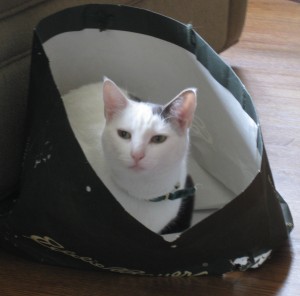
Cat B, aka Domino, is bigger and arguably crazier than Gabby, and she’s made it clear that this house isn’t big enough for both of them. Which is funny, when you consider that Domino is, for the most part, a very sweet and easy-going feline, never happier than when curled up inside her Eddie Bauer bag. She loves that bag with a passion. She disdains the over-priced feathery catnip-laced playthings we’ve bought to try to limit her impact on what’s left of our furniture. She’d rather climb in the bag, wrestle with it, sneak across the room under cover in it, poke holes in it and occasionally nap in it. But she’s not about to share it, or anything else.

Happiness is in the bag.

It was funny at first. But you know how it is with a running joke. Eventually even the best joke needs a nap. I sure do. I tell myself things are going to get better, any day now. They’ll have some sort of breakthrough, look into each other’s mad yellow eyes across a crowded room and realize, hey! Let’s give peace a chance!

Sure. It’s going to happen. Spring is here. Love is in the air, floating like pollen. Or fur.

Don’t get me started.

There’ll Always Be A Festival

The fortieth anniversary of Woodstock is coming up this summer. Got your tickets yet? Or planning just to crash it?

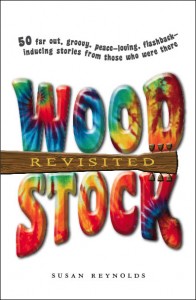
I didn’t go to Woodstock. At the time, other diversions claimed my heart. But lots of people I know went. One of them, Gayle Nourse, wrote a short story called “Peace, Man” about her experience there. The story was selected to be included in Woodstock Revisitedwoodstock-revisited, 50 Far Out, Groovy, Peace-Loving, Flashback-Inducing Stories From Those Who Were There by Susan Reynolds, which will be released this summer, just in time for all the nostalgic hoopla. Love that hoopla.

While the original spirit of Woodstock may have been corrupted by the corporate takeover that brought us five dollar bottled water, ATMs and eventually fiery rebellion at the thirtieth Woodstock, the current of countercultural idealism still runs deep and strong. But, while many of my generation recall the heady late sixties fondly, few of us wear flowers in our hair anymore, and even if we may don the occasional tie-dyed T-shirt, it’s not easy to recapture the extraordinary shared sense of innocence and optimism that flourished in those years before the internet, the cell phone and the iPod came along, ushering in a strange new world of insulated detachment.

There will most likely be some sort of Woodstock commemoration this summer. But as for peace and love? I wouldn’t count on it.

However, that somewhat unhinged but powerfully positive spirit yet lives in Britain, where since 2003 an alternative music gathering called The Green Man Festival offers those who can manage to get there a chance to revel in music, film, theatre, literature, and comedy for three days in the sequestered pastoral Glanusk Park, Wales. The event has already been blessed by the local Druids, to ensure lovely weather for the campers. With its five stages of indie, psychedelia, folk, and “americana” music, not to mention the all-night bonfires and earnest environmental and social justice agenda, The Green Man Festival appears to offer a glimpse of the starry-eyed dream of Peace on Earth.

Will we ever see it for more than three days at a time? And will it ever feature better portable toilets?

The dream is alive.