
Spring Break
Listen closely. Birds are twittering in the bushes. Teenagers are tweeting in the classrooms. The sounds of spring are everywhere. But that gnashing and grinding that you may hear off in the distance is the result of the inevitable winding up of the overworked engines of protest here in Seattle.
The causes vary. There’s the ever popular tunnel vs viaduct debate, which rages on in spite of numerous studies and referendums. There’s the hotly contested issue of naked baristas in the tiny drive-thru espresso huts. There’s endless serious concern over the health of the salmon, the clams, and the waters of the Puget Sound.
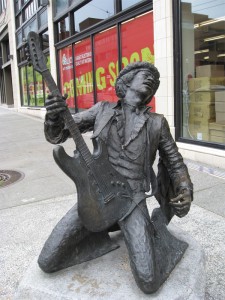
One recent debate seems to have been put to rest, at least temporarily. The life-size statue of Jimi Hendrix which has graced the sidewalk of Broadway Avenue in Capitol Hill for the last thirteen years is going to stay put, rather than be moved to the newly planned Jimi Hendrix Park across town. Personally, while I understand the reluctance of residents of Capitol Hill to lose the statue, I have to say that it seems somehow wrong for Jimi to be stuck out by the curb next to the recycling. I’d like to see the statue on a more elevated site, perhaps near an outdoor stage at the new park. But apparently the majority of residents don’t share that view. And that’s fine. Democracy in action, or inaction. Whatever.
The latest hot issue may generate more high profile debate, however. The proposal to create a new privately operated museum at the Seattle Center dedicated to the work of glass art genius Dale Chihuly has stirred up a pot of contention. And it’s going to be a tough call any way it goes down.
On the one hand are the people who worry that there are already too many high dollar tourist attractions at the Center at the expense of precious open space for Seattle residents. The proposed Chihuly building would take over a portion of what was once the very popular kiddie ride park, the Fun Forest. But on the other hand, the Chihuly project would generate much needed revenue for the Center as a whole, and, occupying an estimated one and a half acres, it would take only a fraction of the Center’s 74 acres.
Still, it would make one more place downtown off-limits to those without disposable income. And that’s hard to support. Not when there are so many other neighborhoods in Seattle with space to spare which could benefit from the presence of a stellar attraction. Is it really such a good idea to concentrate all of the city’s major tourist sites in one small quadrant? Or is that the idea? To contain the cruise ship influx?
I’m a fan of Chihuly’s work, of course. There are already more than a few places to see it around town, but it requires a scavenger hunt approach and a good pair of hiking shoes. To have a formal collection of it in one place makes sense. Should that place be the Seattle Center?
Debaters, start your engines.
We’ve all seen it. On the news, in movies and cartoons. It’s a man-made icon of one of America’s most compelling products. Its image evokes a land of golden opportunities, bright stars and happy endings. And it’s threatened by development.
The Hollywood Sign has loomed in tilted splendor above sprawling Los Angeles since 1923. In the beginning, no one expected it to become a national landmark, much less a treasured symbol of an industry that markets dreams to the world. In a way, the Hollywood sign represents the imaginary romance of LA, in the same way that the Eiffel Tower represents the imaginary romance of Paris. At the time of its construction in 1889, many Parisians considered the Eiffel Tower an eyesore and a waste of money. Yet in time the city embraced the tower, and it became symbolic of all things French. In Hollywood, surely no one expected the 45-foot-high crude letters on a mountainside to become legendary, yet so they have.
In the eighty-seven years since it was first built as a temporary advertisement for “Hollywoodland” the sign has been restored a few times, most recently in 1978 when the original letters were replaced with steel thanks to the philanthropy of major Hollywood supporters including Roy Rogers and Alice Cooper. The sign itself is now owned and maintained by the Los Angeles Department of Parks and Recreation. But the 138 acres of open space behind the sign which provide its dramatic backdrop are now threatened by development. Supporters are trying to raise 12.5 million before April 14 to protect the mountain on which the Hollywood Sign stands for all time.
It could be argued in a world like ours, where tragedy and chaos devastate lives with depressing regularity, that to put money and effort into saving a mere symbol of the creative imagination is frivolous, if not reprehensible. But I would argue that the human ability to imagine a better life, to hope for an end to suffering, to dream of a better future, is what enables us to continue fighting to mend our world. And Hollywood, for all its flaws, feeds the flames of hope all over the world.
You can say I’m a dreamer. But I’m not the only one.
It’s been a week since the Olympics in Vancouver ended, but I still can’t get that anthem out of my head. It seemed like every time you turned around somebody on a podium was getting misty-eyed as they lustily sang along to “Oh Canada.”
Why don’t we have a song like that in our country?
I know, we have a national anthem. But wouldn’t it be cool if it were the sort of song normal people – not necessarily trained in light opera or gospel powerhouse – could sing?
Controversy over national anthems is nothing new, of course. Even in Canada apparently they’ve had long-running debates over the translation of their anthem (the original was in French – mon dieu!; and they also have an Inuktitut version). Here in the fractious United States there have always been champions of other anthem contenders such as “God Bless America” – the easiest to sing by far, “My Country T’is of Thee” – the first patriotic song many public school children learn, and my personal favorite, “America the Beautiful.” Over the years there have been nominations for a handful of other spirited songs – Woody Guthrie’s “This Land is Your Land,” and Bruce Springsteen’s “Born in the USA” among them. But in the land of the free-for-all and the home of the reckless, it’s pretty hard to get a consensus on anything, even something as seemingly innocuous as a song.
Yet the power of music to motivate and lift the spirit is undeniable, and for that reason the importance of a national anthem which the people of the nation can actually sing is not insignificant. During the Olympics we get a chance to hear the anthems of a variety of nations (or at least any of them who happened to be sharing the podium with an American, since our television coverage gives the impression that the only medals which count are those won by Americans – but that’s another rant).
I have to say that for the most part, the anthems of other nations don’t register with me. “La Marseillaise” is an exception, thanks in part to the unforgettable scene in “Casablanca” where Victor Laszlo leads the oppressed patrons of Rick’s Café Américain in a rousing rendition which drowns out the competing Nazi oppressors at another table. A minor victory, perhaps, but a telling one.
Which illustrates the problem with “The Star-Spangled Banner.” Suppose teams of singers were chosen at random from the spectators at a soccer game between the United States and France, and they had to compete in a simultaneous sing-off of national anthems. I think we all know what would happen. The US team would start off boldly, but the song wasn’t designed to be sung by average people. The melody swoops up, it swoops down, it almost never settles into a steady rhythm, and it ends with a killer high note. Thanks a lot, Francis Scott Key.
To its credit, TSSB is a stirring song. Like “La Marseillaise,” it’s a battle song, fit for football kick-offs and baseball diamonds. But, it ain’t hummable. Unlike that Canadian number. Man, there’s a catchy tune. Like a slow-moving train.
Here’s when it hit me. I was watching the men’s final of the curling event. Yeah, I know. I never thought it could happen to me, but you know how it is. You start by watching a few rounds, just for laughs, and then you realize that it’s a kind of prehistoric version of billiards crossed with shuffleboard, and it casts its own hypnotic spell. Plus there’s the pleasure to be had from any mystery, i.e., what the hell’s going on? The Canadian men were fighting for their first gold against a skilled Norwegian team who had generated a lot of media buzz due to their pants. That’s right. I said pants. When all about you are wearing sober black and you show up in harlequin red and gold, it gets noticed.
Anyway, things were rolling along in the sedate, some might say catatonic, way of the sport. A general air of civility and quiet was evident in spite of the growing excitement among the Canadian fans that they might actually make history. And then it happened. Sometime around the ninth end (a technical curling term), from the Canadian fans a soft sound grew as the familiar strains of “Oh Canada” rose on a fervent swell of national pride. This was unprecedented! Singing in the seats at a curling event? The players waited, bemused expressions on their faces, even the Norwegians, who by then could read the cursive on the wall, until the song ended, and a polite cheer went up.
This could never happen at, say, an American hockey match. And it’s not because we don’t all know the words to TSSB. It’s because the song wasn’t written for ordinary mortals to sing, not even ordinary mortals who’ve had a few beers and are feeling fairly invincible.
But “Oh, Canada” has the kind of easy-going, middle-of-the-road range that any child can sing. And it’s not about bombs bursting and rockets glaring. It’s about brotherhood and love of country. That’s all I want in a national anthem. At least until we can all agree on Bruce Springsteen.
