Write or Wrong

I can’t relate to Kindle.
The iPad leaves me cold.

I understand that the publishing industry is running scared. Fewer people read books these days. Fewer still buy them. Profit margins are shrinking, and publishers are grasping at any device to lure customers away from movies, television, and video games and back to the printed word.

I have friends who adore their high tech gadgets. But I cannot embrace a future without books. And when I say books, I mean the kind with paper pages that whisper softly as you turn them, that get stained but don’t die when you spill coffee on them.

So, being the deluded optimist that I am, after reading in  The New Yorker how Apple founder Steve Jobs asserted that forty percent of Americans read only one book or less in the last year, I choose to focus on the positive side of that statistic. Math was never my strong suit, but it seems to me that the other sixty percent must be reading at least one book a year. In fact, according to  some sources, the Americans who do read tend to read an average of twenty books a year (http://BookStatistics.com). Not too shabby.

However, we all know that statistics were invented to facilitate obfuscation.
What has me worried is the idea of a future in which children don’t sit in their parents’ laps listening to “Goodnight Moon,” or “Where the Wild Things Are,” but instead watch a video played on a flatscreen mounted in the crib. I suppose that seems fairly harmless to the generation whose children have grown up watching videos in the family SUV.

Of course sci-fi writers have been painting ominous pictures of dystopian futures for some time, but the disturbing truth is that reality  has a way of outdoing fiction for flat-out bizarre terror. I recently read a deeply disturbing yet brilliant book about an all-too possible future where the kind of non-stop video and internet info-slush-pile no longer takes place outside the human body in a handheld device. In “feed,” M.T. Anderson’s 2002 prize-winning young adult novel, children are implanted with a transmitter that keeps them continually updated, connected and marketed to in a world which has become toxic through pollution and corporate over-reaching. In the context of Anderson’s imaginative vision, the notion of reading a hand-held book seems laughably out-dated. But the chilling message of “feed” reveals the danger of surrendering our autonomy to giant powers outside ourselves, who decide what stories will be told, and how.

Stories have power. Every religion is founded on a story. Something precious is lost when we lose our ability to give and receive the spoken and written word. I’m not saying there’s anything inherently wrong with the iPad and the Kindle and the Nook, and whatever comes after them. But I hope in our rush to “improve” the technology of the book we don’t lose sight of what really matters.

Written books are the notes we pass in the classroom of human history. Pssst. Pass it on.
Glee Fool

Glee is one of those odd words which conveys in one short syllable both a giddy positivism and its twisted darker side. It’s a slightly psychotic word.

Perhaps that’s why it’s so apt as the title of the latest Fox network hit, which revolves around the bright hopes and delusional romances of a group of musically gifted high school students and the Machiavellian machinations of the cheerleading coach determined to destroy them.

Gosh. If that’s not good TV, I don’t know what is.

Well, truly, I don’t think I would ever make the cut as a TV programmer, since every show I like tends to get cancelled after one season. “Freaks and Geeks,” for instance. Now there was a brilliant, funny, subtle show about the American high school experience. The cast in that show hardly every broke into song without irony. Ah well, at least many of them, such as James Franco and Seth Rogen, have moved on to illustrious or less lustrous careers in show biz.

The cast of “Glee” has already won a Golden Globe for its first season, which suggests that the actors may be stuck in high school for a bit longer than the customary four years. And I must confess, I do like “Glee,” in part because it’s so far removed from any reality I experienced in high school back in the pre-tech age, when a student could be sent home for wearing sandals, or a skirt which didn’t reach the knee. Back when “classic” rock was cutting edge.

But I digress. “Glee” is put together with the clear-eyed marketing savvy of a soft-drink campaign. Suffice it to say that in my day no member of the football team, much less the star quarterback, would have also been singing and dancing in the glee club. But in “Glee” the cast is a triumph of precision political correctness, with representatives from a rainbow of ethnic groups, as well as a token gay member, a few handicapped and a misunderstood diva in the Barbra Streisand mold before it set.

What prevents the show from being as insipid as a Pepsi ad is the gleeful venom of the antagonist, the cheerleading coach Sue Sylvester, played with verve and crisp conviction by Jane Lynch, an actress who for years has added panache to standard sitcom fare such as “Two and Half Men.” It’s great to see Lynch enjoying herself in this nasty role. Without her, “Glee” would sink from the weight of its relentless power pop numbers and flashy dance routines. I mean, seriously, what are these kids doing in high school when they obviously belong on Broadway?

The answer, of course, is that they aren’t in school. It’s make-believe as far removed from reality as any “reality” show, only a lot more fun to watch.

That said, it can’t last. If I like it, it’s doomed.
Mwah hah hah.

The Big Tease

Rainy Day Tulips
Rainy Day Tulips

They’re doing it again.

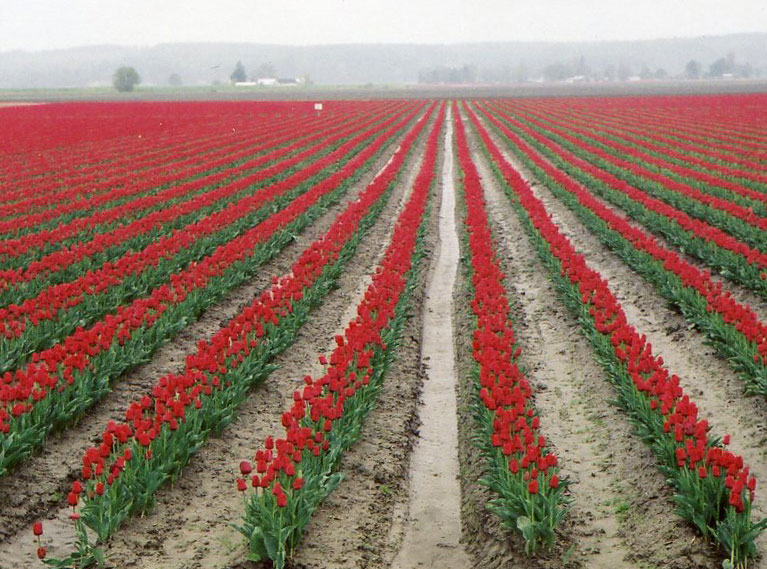
Up there in Skagit Valley, where the land flattens out for miles and the snow geese arrive in feathered clouds each spring, the tulips are tempting.

I succumbed to the call when I first moved to Seattle four years ago. I thought what could be more thrilling than acres and acres of tulips in bloom?

I can laugh about it now.

Veterans of the Pacific Northwest know all too well that only an idiot would expect to tiptoe through the tulips in early April, when the annual Skagit County Tulip Festival gets underway. The sadder but wiser tulip enthusiast wears full-body Gore-Tex and carries a sturdy full-size umbrella. For, although it is true that when the tulips bloom, the fields light up, it is also true that the sun is under no obligation to make an appearance.

The year I went, the temperatures were hovering in the low forties, wind gusts were in the teens, and a bracing drizzle completed the ensemble. Before I’d managed to shoot my compulsory two dozen snapshots, my nose was red, my lips were blue, and my teeth were chattering. Good times.

I’ll always remember that day for another reason, too. When I got home with my frozen feet and chapped face, I was drinking a restorative cup of cocoa when I opened my email and found a gushing note from my then-publisher, who was halfway through reading my second novel and loving it. She assured me she would be contacting me soon and that I could “expect good news.”

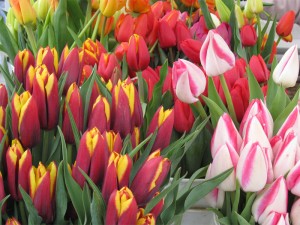
Pucker Up
Pucker Up
Hah, hah. Yes. I can laugh about it now.

Still, I’m glad I went to the tulip festival, if only because now each year when the forecasters begin the tulip drum roll, I don’t feel the urgency to salute. Been there, survived that. I’d do it again. Probably not this year, though. After we had the warmest January on record it seems we shot our wad for warmth. Since then it’s been back to the good old forty degrees with intermittent showers that we all know and love so well. It’s not so bad as long as you can find a nice warm bookstore or cafe to while away the wet hours. And of course it makes it easier to stay inside at one’s desk and work on that next novel. The one that’s sure to find a loving home somewhere.

The sun will come out eventually. I’m still expecting good news.

The Miraculously Mellow Manatee

What's Not To Love?
What's Not To Love?

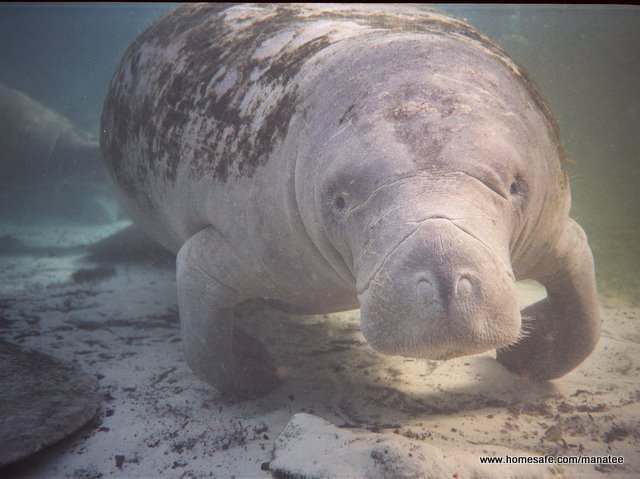
What strikes you first about a manatee is not its size, or its enigmatic expression, but its almost mystic aura of calm.

This is all the more striking when you happen to be with a group of excited tourists all eagerly flapping around trying to get close enough to touch and snap pictures of the elusive creature, whose endangered status grants it some degree of protection from its admirers. But perhaps not enough.

When my son encouraged me to join him on a snorkeling adventure to see the manatees up close and personal, I was hesitant at first. Although I enjoy swimming, I’m terrified of alligators, and in Florida they’re everywhere. However, since we would be snorkeling in a group of fifteen, I swallowed my fear and banked on the safety in numbers.

We had to be at the dive shop at the crack of before dawn, since manatees are particularly sensitive to water temperatures. Too cold and they die. Too warm and they stop moving around. To catch sight of them in the shallow lagoons of Crystal River, Florida, you have to get in the 72 degree water before eight a.m. And before you leave the dock you have to get into a wet suit and watch a video informing you of all the rules and “manatee manners” which are strictly enforced to protect the manatees from their hordes of admirers.

In my naiveté I had thought that when we arrived at the site it would be just us and the manatees. But when our guide cut the engine and dropped anchor there were a half dozen other tour boats already on the scene. There were also several observers in kayaks from manatee watch groups to enforce the rules and make sure none of the snorkelers forgot their manners.

At the sight of all these humans and boats my expectations for a memorable manatee moment fell. If I were a manatee I certainly wouldn’t want to stick around while scores of gawking humans stirred up the water. But it seems that manatees are far more mellow than I.

When the first one drifted past me, its little flippers comically small in relation to its portly bulk, it floated so serenely, seemingly without effort, like an underwater dirigible. Its mild demeanor and whiskered nose put me in mind of Wimpy, the cartoon character famous for his fondness for hamburgers, although the manatee is an herbivore, its preference for grass earning it the nickname “sea cow.”

However, unlike clumsy cows, the manatee’s graceful movement and gentle calm suggest an almost magical poise. They are innately loveable creatures. It’s easy to understand how sailors seeing them in the distance long ago might have imagined they were mermaids. Obviously those long sea voyages were a strain for lonely sailors.

For the manatee, whose existence is threatened by loss of habitat, global warming, power boats and reckless human behavior, the hope for continued survival depends not only on managing the threats to its habitat, but on managing the natural human desire to get closer to the things we love. Manatees don’t appear to have the instinct to fight off intruders. Maybe it’s a miracle they’ve lasted this long. But I hope we can keep the manatee miracle going.